Policies
How biomarker signals become domain-specific insights.
Biomarker models produce continuous signals — distress, stress, emotion, clinical indicators — but a score alone doesn’t tell a tutoring platform to slow down, or a wellbeing agent to check in. Policies are the interpretive layer that sits between raw biomarker output and your application. Each policy encodes domain-specific logic: which signals matter, what patterns to watch for, and what actions to recommend when thresholds are crossed.
How policies work
Biomarkers process the audio
Biomarker models (Helios, Apollo, Psyche) analyse the audio and produce scores across dimensions like distress, stress, emotion, and clinical indicators.
Policies trigger on a turn-based schedule, not audio duration. A turn is each time the user or agent speaks. Policies run every N turns (configurable per policy) using the biomarkers available at that moment.
Configuring policies
Policy configuration is handled by thymia based on your use case — including biomarker selection, thresholds, sensitivity, output format, and domain-specific reasoning. You select which policies to activate when connecting to Sentinel.
Example: a student monitoring policy
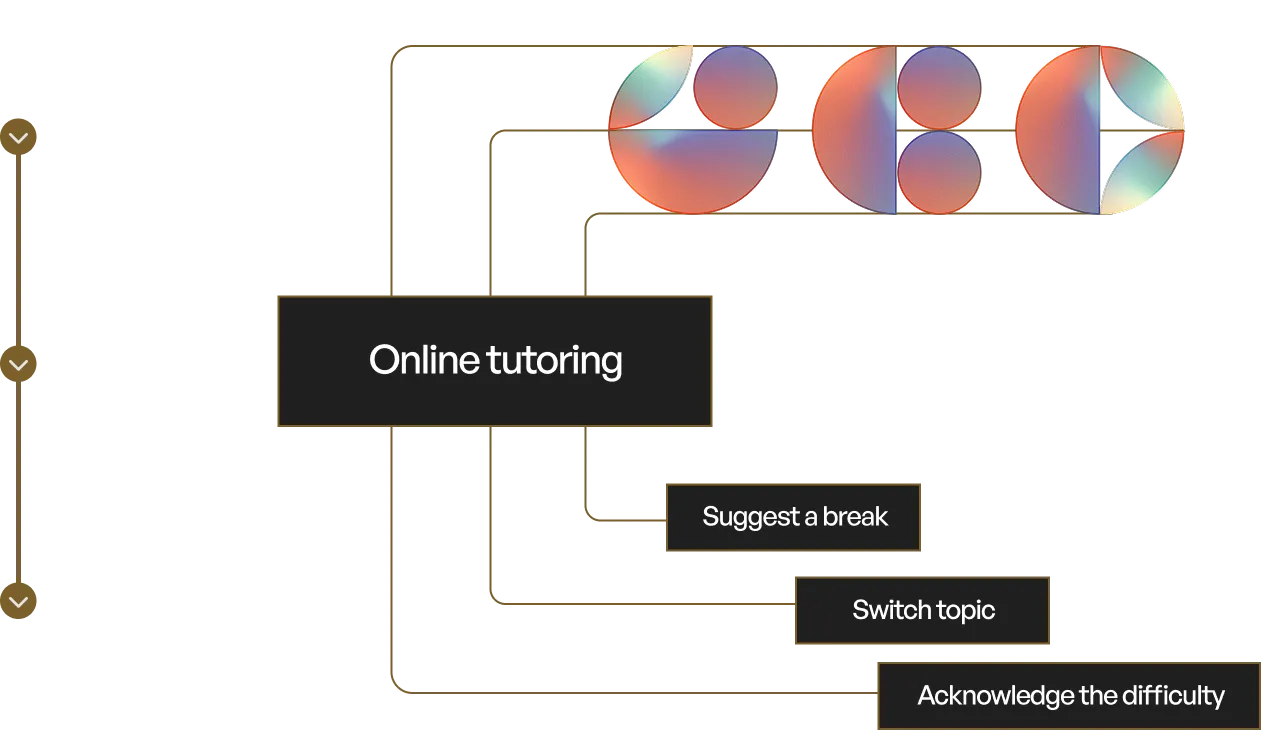
Consider a policy configured for an online tutoring platform.
Sentinel streams audio from a live tutoring session. Biomarker models detect that the student’s stress is rising, fatigue is elevated, and vocal tone is shifting toward frustration — while the transcript shows the student has stopped answering questions and is giving short, disengaged responses.
Individually, none of these signals are conclusive. Elevated stress could be productive effort. Short responses could be focus, not disengagement. The policy combines them: when stress, fatigue, and linguistic disengagement cross a configured threshold within the same conversational window, the policy triggers. Sentinel returns a single, domain-appropriate result — the student is struggling — with a recommended action: acknowledge the difficulty and suggest a break or topic switch.
The tutoring agent adjusts its approach in real time. No human needed to intervene.
This same pattern applies across any domain — healthcare, contact centres, coaching, safety monitoring — with different biomarker combinations, thresholds, and recommended actions tailored to each context.
Multiple policies
Multiple policies can run simultaneously on the same conversation. Each triggers independently, so a single session could monitor wellbeing, extract structured data from the conversation, and track engagement — all at once, each producing its own results.
Custom policies
Policies are fully configurable. thymia works with you to define the biomarker combinations, thresholds, and domain logic that match your use case — whether that’s agent evaluation, interview anxiety detection, therapy session quality, or something entirely new.
Contact support@thymia.ai to discuss your requirements.
Next steps
- Sentinel Docs — SDK reference, integrations, and more.